


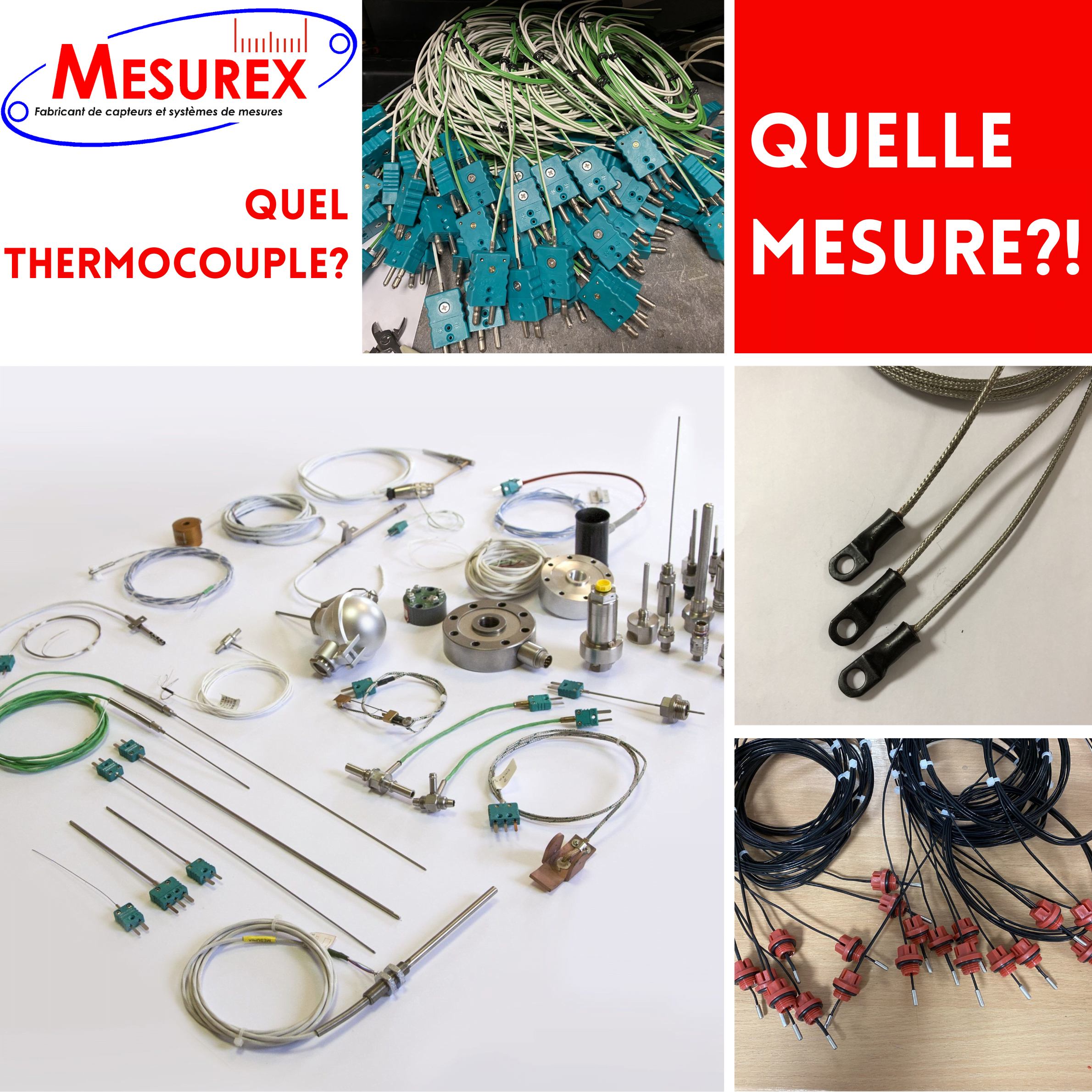
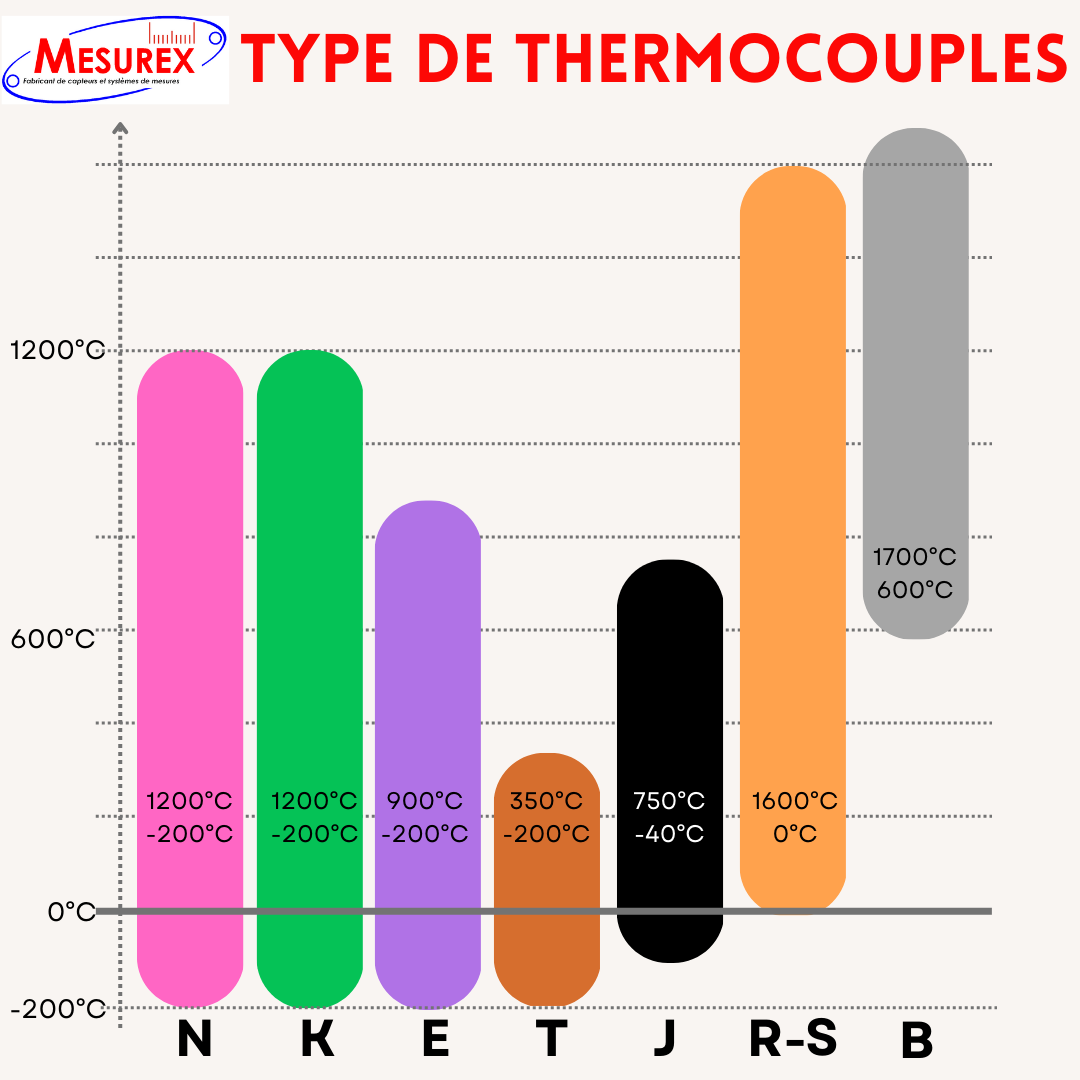
There are many different types of thermocouples, depending on the metal alloys used, but the most common are 8 types are mainly used in our workshops (T, K, N, J, E, R, S, B). Find out which one is right for you.
| TYPE | Alloys used | Mounted under ceramic beads (rigid sheath) |
In jacketed version with outer sheath and MgO (flexible sheath) |
| T | Copper (+) Constantan (-) |
Use: in both oxidizing and reducing atmospheres Its low-temperature stability means greater precision. Recommended for very low temperatures (cryogenics). Operating temperature: -200°C to 350°C |
Usage: between -40 and 350°C Highly stable for low-temperature measurement applications and cryogenics. For use below 0°C, check the compatibility of the outer sheath. |
| K | Chromel (+) Alumel (-) |
Use: reliable and precise, it is used extensively for temperatures up to 1200°C. In a reducing atmosphere (presence of carbon dioxide): protect this thermocouple with a metal or ceramic/alumina tube. In an oxidizing atmosphere (e.g. electric furnace, presence of oxygen), protection is not necessary. Generally longer service life than type J, which will oxidize more quickly (especially at high temperatures). Operating temperature: -40°C to 1200°C |
Usage: between -40 and 1200°C . Between 315°C and 600°C, MESUREX recommends type J or N, as instability in the structure of the internal alloys will cause a drift of around +2°C after a few hours' use. Excellent solution for nuclear environments. |
| N | Nicrosil (+) Nisil (-) |
Use: mainly at high temperatures up to 1250°C. Better resistance to oxidation at high temperatures and longer service life in applications where sulfur is present. No premature ageing problems (like type K). Operating temperature: -40°C to 1250°C |
Usage: between 0 and 1250°C. Very stable over time with no drift at high temperatures. High-temperature applications require Pyrosil, Alloy TD or Nicrobel sheathing. Type N is particularly recommended for nuclear applications. |
| J | Iron (+) Constantan (-) |
Usage: protected or unprotected, subject to absence of oxygen. Protection will prevent oxidation and extend service life. As the positive conductor is iron, it oxidizes rapidly above 540°C. The use of a simple conductor with a larger diameter will increase its service life. Temperature range: -40°C to 750°C. |
Usage: between -40 and 750°C . Greater stability between 0 and 538°C than types E and K (drift associated with ageing). Very economical thermocouple, mainly with stainless steel sheath. |
| E | Chromel (+) Constantan (-) |
Use: less commonly used, but nevertheless a good choice for temperatures up to 900°C. Recommended for vacuum, inert gas, moderately oxidizing or reducing applications. For cryogenic applications, it is not subject to corrosion. Type E generates a higher voltage signal than all other thermocouple types. Operating temperature: -40°C to 800°C |
Usage: between 0 and 900°C. Between 315 and 600°C, however, MESUREX recommends type J or N (drift associated with ageing). . |
| R | Pt 13% Rh (+) Pt (-) |
Thermocouples for high temperatures. Operating temperature: Type S or R from 0 to 1600°C Type B from 600 to 1700°C. These thermocouples are easily contaminated, so they should not be used in a reducing atmosphere. These noble metal thermocouples should preferably be protected by a ceramic tube (alumina) or by an outer metal tube below 1200°C. |
Because of the high operating temperature of these thermocouples, the external metal sheath will often be an obstacle to their use. Products offered with Inconel or platinum sheaths (very costly), mainly for type S. Operating temperature: Type S 0 to 1250°C. |
| S | Pt 10% Rh (+) Pt (-) |
||
| B | Pt 30% Rh (+) Pt 6% Rh (-) |
Precision class: what does the standard say?
| TYPE | Tolerance value | ||
| Class 1 | Class 2 | Class 3 | |
| T | ±0.5 or 0.004×T | ±1 or 0.0075×T | ±1 or 0.015×T |
| -40...350°C | -40...350°C | -200...40°C | |
| E | ±1.5 or 0.004×T | ±2.5 or 0.075×T | ±2.5 or 0.015×T |
| -40...800°C | -40...900°C | -200...40°C | |
| J | ±1.5 or 0.004×T | ±2.5 or 0.075×T | ±2.5 or 0.015×T |
| -40...750°C | -40...750°C | ||
| K | ±1.5 or 0.004×T | ±2.5 or 0.075×T | ±2.5 or 0.015×T |
| -40...1000°C | -40...1200°C | -200...40°C | |
| N | ±1.5 or 0.004×T | ±2.5 or 0.075×T | ±2.5 or 0.015×T |
| -40...1000°C | -40...1200°C | -200...40°C | |
| R & S | ±1 for T<1100°C 1+0.003×(T-1100) for T>1100°C |
±1.5 or 0.0025×T | |
| 0...1600°C | 0...1600°C | ||
| B | ±1.5 or 0.0025×T | ±4 or 0.005×T | |
| 600 to 1700°C | 600 to 1700°C | ||
Temperature limits for sheaths and protective materials.
Thermocouples come in 3 main forms:
-> Bare-wire version with rigid outer tube protection
-> Jacketed version: the thermocouple wires are positioned in a flexible metal tube filled with a mineral insulator (magnesia, aluminum oxide....).
-> Wired version: thermocouple wires are insulated with PVC, silicone, Teflon, glass silk or ceramic fiber.
Flexible wired versions with insulation :
- These versions are used to make single thermocouples or to make compensating or extension cables.
The cable used to build a wired sensor guarantees all the thermocouple's thermoelectric characteristics over the entire temperature range. - Extension cable: used to connect the thermocouple to the measuring instrument; its conductors have the same thermoelectric characteristics and properties as their respective thermocouples.
- Compensating cable: used to connect the thermocouple to the measuring instrument; its conductors have different characteristics from those of the thermocouples to which they are connected, although they retain the same thermoelectric properties.
| Temp. max. °C |
INSULATION | Use | |
| -20...105 | PVC | Good mechanical and electrical characteristics | |
| -40...200 | SILICONE | Excellent flexibility even at low temperatures | |
| -200...250 | TEFLON | Chemical resistance and excellent mechanical properties | |
| -200...400 | KAPTON | Excellent dielectric and chemical properties | |
| 400 | GLASS SILK | Good resistance to high temperatures - non-combustible but porous | |
| 1200 | CERAMIC FIBER | Very good resistance to high temperatures - non-combustible but porous |
Flexible jacketed versions with mineral insulation :
This version consists of a metal sheath containing conductors insulated from each other by highly pure, highly compressed metal oxides. This product offers many advantages: robustness, short reaction time, good insulation, high temperature.
| Type | Temp. max. °C |
Application | |
| 304SS | 800 | General-purpose stainless steel. Good corrosion resistance. |
|
| 316SS | 1050 | General-purpose stainless steel. Superior corrosion resistance. |
|
| 310SS | 1050 | Superior corrosion resistance. Highly resistant to high temperatures. |
|
| 446SS | 1100 | Used in sulfurous atmospheres. | |
| Inconel 600 | 1150 | Excellent resistance to oxidation and high-temperature corrosion. | |
| Pyrosil D | 1250 | Greater resistance to oxidation than 310SS & INC 600. More resistant to high temperatures than 310SS & INC 600. Coefficient of thermal elasticity compatible with nickel alloys (thermocouple type K and N) |
For this type of product, a minimum external diameter must also be respected, depending on the temperature of use:
| Type | Ø0.5 | Ø1 | Ø1.5 | Ø2 | Ø3 | Ø4.5 | Ø6 | Ø8 | ||||||
| 304SS | 700°C | 700°C | 800°C | 800°C | 800°C | 800°C | 800°C | 800°C | ||||||
| 310SS | 700°C | 700°C | 920°C | 920°C | 1050°C | 1050°C | 1050°C | 1050°C | ||||||
| 446SS | 700°C | 700°C | 920°C | 920°C | 1070°C | 1100°C | 1100°C | 1100°C | ||||||
| Inconel 600 | 700°C | 700°C | 920°C | 920°C | 1070°C | 1150°C | 1150°C | 1150°C | ||||||
Rigid versions with external protection tube :
These versions are particularly suitable for very high temperatures. The thermocouple is mounted under a ceramic bead with one or two protection tubes. A DIN head is often used for the electrical connection.
| Type | Temp. max. °C |
Application |
| 446 SS | 1100 | Excellent resistance in salt bath applications (heat treatment). Fairly resistant to aluminum electrolytic baths. |
| Cast iron | 870 | Inexpensive material used in liquid aluminum. The tube has a relatively short life due to oxidation, but other materials also have their drawbacks in this application. Fragile metal. |
| HR-1600 | 1204 | Exceptional resistance to various forms of corrosive attack at high temperatures. |
| Inconel 6011 | 1260 | Highly resistant to oxidation for processes with high to moderate oscillating temperatures. Resistant to sulfur compounds and carbon dioxides at moderate temperatures only. |
| Alumina (99%)1 | 1900 | Used in the glass and non-ferrous metal industries. Highly gas-tight, it provides excellent protection for noble metal thermocouples. |
| Hexoloy SA2 | 1650 | Incinerator, liquid aluminum and non-ferrous metals, hydrofluoric and sulfuric acids, bauxite calcination. |
| Mullite | 1700 | Used in the non-ferrous metals industry and in various industrial furnaces. Highly gas-tight, not recommended for noble metal thermocouples as it contains silica. |
| Syalon3 | 1150 | A strong material, highly resistant to thermal shock. Widely used in the aluminum industry, especially for scuppers. Rather expensive material. |
| Silicon carbide | 1650 | Excellent thermal shock resistance. High thermal conductivity. A porous material which, combined with an internal ceramic tube, provides good protection for noble metal thermocouples. |
Among the many temperature measurement sensors, the thermocouple is undoubtedly the most commonly used product, because it offers good precision while remaining economical.
With so many variations, shapes and protective tubes to choose from, it's not always easy to decide which products to use. Above all, you need to ask yourself the right questions:
What is my operating temperature (thermocouples can measure temperatures from -200°C to +1700°C)?
What is the measurement environment? (liquid / solid / gaseous environment, chemically aggressive environment, extreme conditions...)?
What is the desired level of precision?
How much space is available for these measurements?...
FICHE SYNTHESE: How to choose your thermocouple? Types, specifications, standards, recommendations...
file
https://mesurex.fr/wp-content/uploads/2023/11/MESUREX-Guide-de-selection-des-thermocouples_v2.pdf

 Français
  English