


Objectives of DO-160
- Guaranteeing reliability equipment under extreme conditions (temperature, pressure, vibration, electromagnetic interference, etc.).
- Validate compliance the requirements of certification authorities (FAA, EASA, etc.).
- Simulate real-life environments to anticipate risks of failure.
DO-160: Regulatory framework and challenges for avionics
The standard DO-160, developed by Radio Technical Commission for Aeronautics (RTCA) and recognized by the FAA and the’EASA, is the international standard for environmental and electromagnetic compatibility (EMC) testing of avionics equipment. Since its first edition in 1975, It has evolved to meet the growing demands for safety and reliability in civil and military aeronautics. The current version, DO-160G (2019), defines 26 sections standardized tests, covering all the environmental and operational constraints encountered in flight.
These tests include temperature and altitude, shock and vibration, humidity, fluid resistance, dust, salt fog, electromagnetic compatibility, lightning effects, ice, flammability, among others. The aim is to ensure that equipment can operate reliably in harsh airborne conditions, simulating real-life in-flight environments.
Examples of DO-160 test protocols:
| Test type | DO-160G requirements | Objectives |
| Temperature & Altitude | Beach : -55°C to +85°C ; reduced pressure (up to 15,000 m) | Check thermal stability and resistance to rapid depressurization. |
| Vibrations | Frequencies : 5 Hz to 2,000 Hz ; amplitudes by plant category | Simulate in-flight vibrations (turbulence, engines, landing gear). |
| Mechanical shocks | Accelerations up to 50g ; crash tests (category Z) | Validate impact resistance and safety in the event of an accident. |
| Humidity & Salt spray | Exhibition at 95% HR ; salt spray (5% NaCl) for 48h | Evaluate resistance to corrosion and water infiltration. |
| EMC (Electromagnetic Compatibility) | Immunity to radio frequencies (10 kHz-18 GHz), lightning transients (level 3/4), electrostatic discharges | Ensure immunity to interference and non-disruption of other systems. |
| Leak testing and fluid resistance | Exposure to fuels (Jet A-1), oils, hydraulic fluids, detergents, dust, sand... | Prevent degradation of materials and seals. |
Each test is broken down into precise procedures defined in the corresponding sections of the DO-160 standard (of which there are 26), with requirements varying according to the type of sensor, its use, its installation in the aircraft (e.g. cockpit, hold, wing) and the type of aircraft (commercial aircraft, helicopter, drone).
MESUREX expertise: DO-160 design, qualification and certification
DO-160-compliant design right from the start
We design sensors capable of withstanding the extreme conditions encountered in flight, integrating DO-160L requirements right from the development phase (compliance matrix, choice of materials, integration of sealing constraints, EMC shielding, etc.). Our design protocols are based on rigorous technical control (digital simulation to anticipate thermal and mechanical constraints), to guarantee compliance with the precise criteria of the standard at every stage, thus increasing the chances of success in qualification tests.
Complete test management and qualification procedures (QTP)
We can manage complete qualification processes, drawing up and managing the necessary Qualification Test Procedures (QTP). These precise, standard-compliant protocols are deployed in independent, accredited laboratories. Our rigorous management ensures total technical and regulatory compliance, while keeping your programs on time and on budget.
Expert drafting of qualification reports and files (QTR)
Our team has the advanced writing skills to synthesize test results into a comprehensive Qualification Test Report (QTR) in English. This report is a reference document, facilitating regulatory validation and traceability of your project.
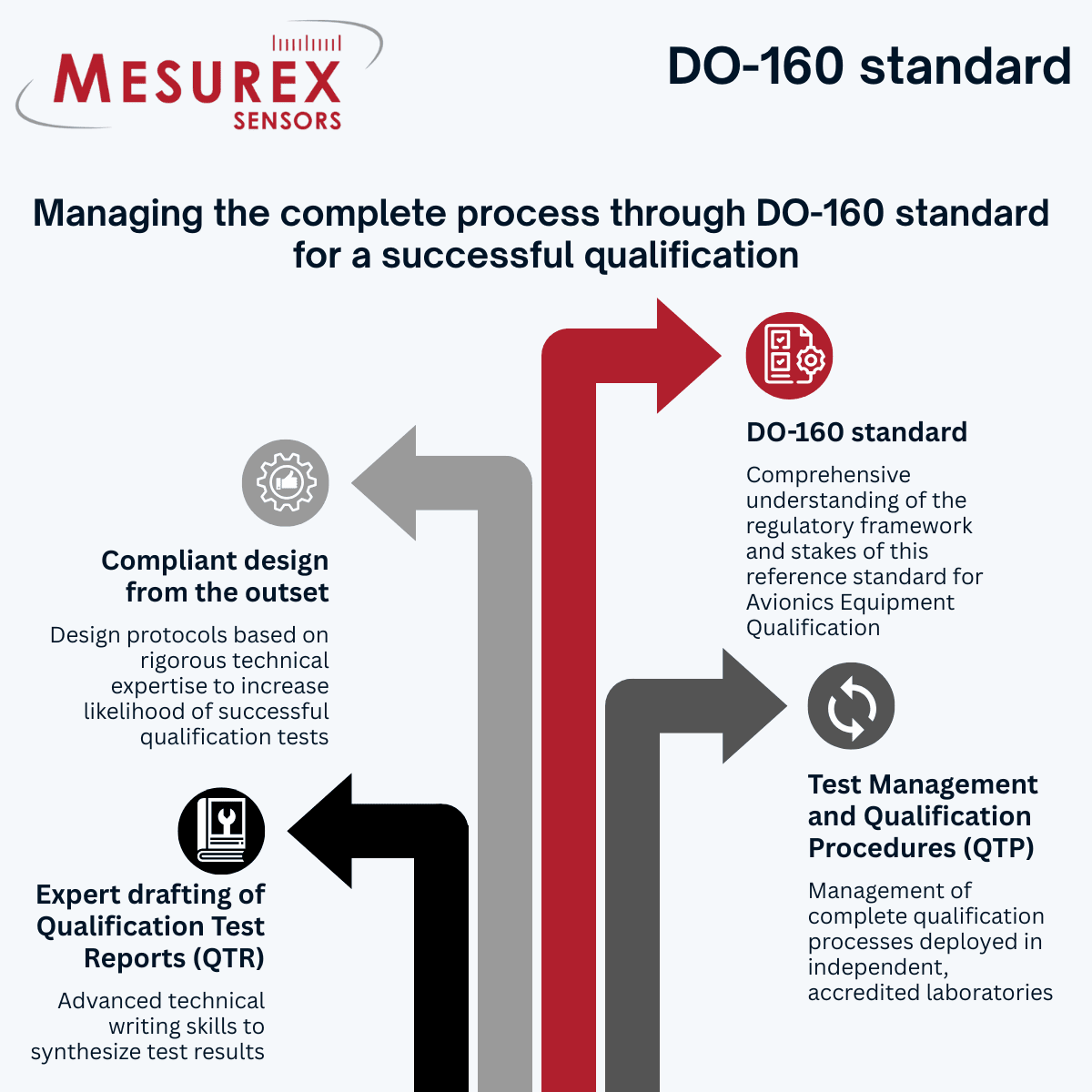
From design to certification, including laboratory test management, our expertise guarantees the success of your aeronautical sensor projects, in compliance with the DO-160L standard. Today, several ranges of MESUREX PT100 or thermocouple sensors are certified in flight for major players in the global aerospace industry.
Rely on our experience to develop innovative, resistant and certified products, while ensuring that their technical documentation complies with aerospace industry standards.
me*****@*****ex.fr // 01 30 41 23 62

 Français
  English